
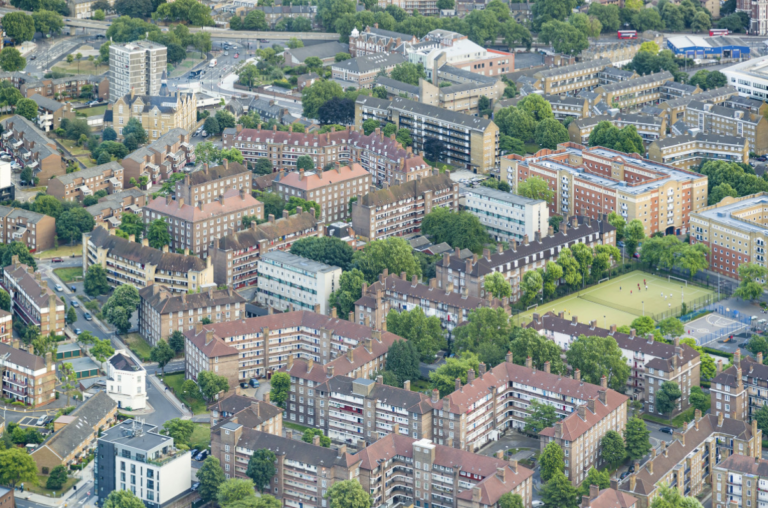
If you run a business in Merton, or neighbouring areas like Wimbledon, Mitcham or Morden, you’ve likely heard the buzz about Central London’s property market.
So why does this matter to you? The answer lies in the ripple effect: as habits around how people live, work, and invest in the capital shift in Central London, the impact begins to affect the outer boroughs.
Interestingly, though, Merton is well-positioned to benefit from evolving trends.
A strong market finding its footing again
London’s property market is entering a period of recalibration underpinned by many investors exercising cautious optimism, as eloquently explained by London-based estate agents Hudsons Property. After years of volatility driven by high mortgage costs, political uncertainty (which hasn’t exactly eased, based on recent weeks), and shifting buyer dynamics, activity in the capital is beginning to settle into a more balanced pattern.
One particularly noticeable driver of this shift is the cost of borrowing. The Bank of England reduced the base rate several times by late 2025, meaning that mortgage rates are now softer than they were over the previous few years. This, by extension, is increasing affordability for buyers and removing some of the most profound obstacles seen in this high-value environment. For businesses, this matters tremendously because with greater buyer confidence comes more people moving, spending, and rooting in the capital, which directly translates into better local commerce.
At the same time, the Central London market is shifting. Demand for premium, well-situated properties in the centre of the city remains strong, with luxury apartment sales continuing to increase, particularly among international buyers returning to the market. This concentration of demand in the city is, paradoxically, one of the reasons why the surrounding boroughs are seeing growing interest. Experts predict that most London boroughs will see property values increase incrementally, which also spells good news for buyers.
Looking beyond the centre
When Central London prices are expected to stabilise as a whole, buyers and renters who choose not to or simply cannot compete at that elevated level, understandably, look further afield. With property prices in Central London already exceptionally higher than average, more buyers are seeking affordable options elsewhere, with regeneration efforts in areas like Croydon, Barking and Tottenham, and transport improvements like Crossrail 2 and London Underground upgrades increasing demand in well-connected areas. Renowned Homes predict that outer London areas will see major growth as a result of these upgrades.
Merton sits firmly within this growing trend. As a borough served by the Northern Line through Colliers Wood, South Wimbledon and Morden, the District line into Wimbledon, and a robust overground network, it’s one of the better-connected outer boroughs in South West London. Recent figures from Merton Council say that the borough is home to over 200,000 residents living in 80,000 households, served by 7,000 businesses across an area spanning 14.7 square miles. The area may therefore be seen as a natural successor for those looking beyond the rising costs of Central London without sacrificing urban connectivity.
For local business owners, an influx of new residents will mean, on paper, more customers, footfall and talent to recruit from, potentially. Wimbledon town centre has, according to Love Wimbledon, already begun to reflect this momentum, with the town’s spending increasing by 122% between 2019 and 2023, and footfall increasing 9.5% over recent years. Mitcham, meanwhile, is the subject of ambitious regeneration activities, with 146 new homes approved for social rent at the former Mitcham Gasworks site, as per the council’s newsroom earlier this year.
Geopolitical uncertainty adds another layer
It would be remiss not to acknowledge other wider contextual issues. As per a recent MoneyWeek article, house prices were returning to positive growth in early 2026 after a stagnant 2025, but the ongoing geopolitical tension may dissuade some investors from taking action. However, uncertainty like this invariably accelerates a flight to stability, and outer London boroughs with strong residential footprints, good schools, and green spaces will typically hold firm during turbulent periods. Merton fits that profile certainly.
For businesses, periods of wider uncertainty call for more proactive planning, which means that business owners should consider reviewing whether their local population is contracting or expanding, and being more frugal or ambitious. It may warrant a repositioning of your products or services to meet potentially new market segments, rather than chasing a target market that’s already moved on, or that has begun to prioritise different qualities.
Looking at recent analyses, the data is painting a picture of a market that is stabilising rather than explicitly surging. Domestic buyers, particularly younger working professionals and first-time house purchasers are expected to drive the majority of activity. This demographic is the exact one that tends to settle in outer London boroughs like Wimbledon and Morden, where value, transport links, and quality of life are all more manageable.
Why a buoyant centre is good news for Merton
A healthy Central London market does not crowd Merton out; it feeds it. When the City of London centre is active, displacement demand flows outward. Mortgage rates easing means that more buyers will be able to buy, bringing new households to the borough, and when Merton itself is investing in workspaces, housing, and regeneration efforts, it becomes an active destination rather than somewhere that displaced Central Londoners go when the centre’s overflowing.
Merton is a London borough on the rise, working to build a borough where residents and businesses flourish in thriving, sustainable local economies. A business-friendly environment where businesses of all shapes and sizes can grow and prosper. For business owners in the area, the salient takeaway is that the conditions that drive more residents this way are firmly in place, and those best poised for that growth, rather than passively waiting for it, will be those that capitalise on it.
[Image source: Deposit photos]